Project overview
DigiMic (Digital Microbiome) is an open modelling framework for exploring how microbial communities assemble, respond to environmental change, and process carbon. It connects mechanistic models of microbial metabolism with community dynamics and, ultimately, observations from laboratory and natural ecosystems.
Why model resources?
Microbes do not interact in isolation. They consume shared resources, retain some of that material for growth, and release metabolic by-products that other organisms may use. These flows create competition when organisms require the same resources and cross-feeding when the products of one organism support another.
DigiMic represents these processes with microbial consumer-resource models (MiCRMs). Uptake parameters describe resource consumption, leakage parameters describe the release of metabolic by-products, and retained uptake contributes to growth. Resource supply, environmental loss, and microbial mortality complete the community dynamics. This mechanistic structure lets researchers ask how traits, metabolism, and environmental conditions shape whole-community behaviour.
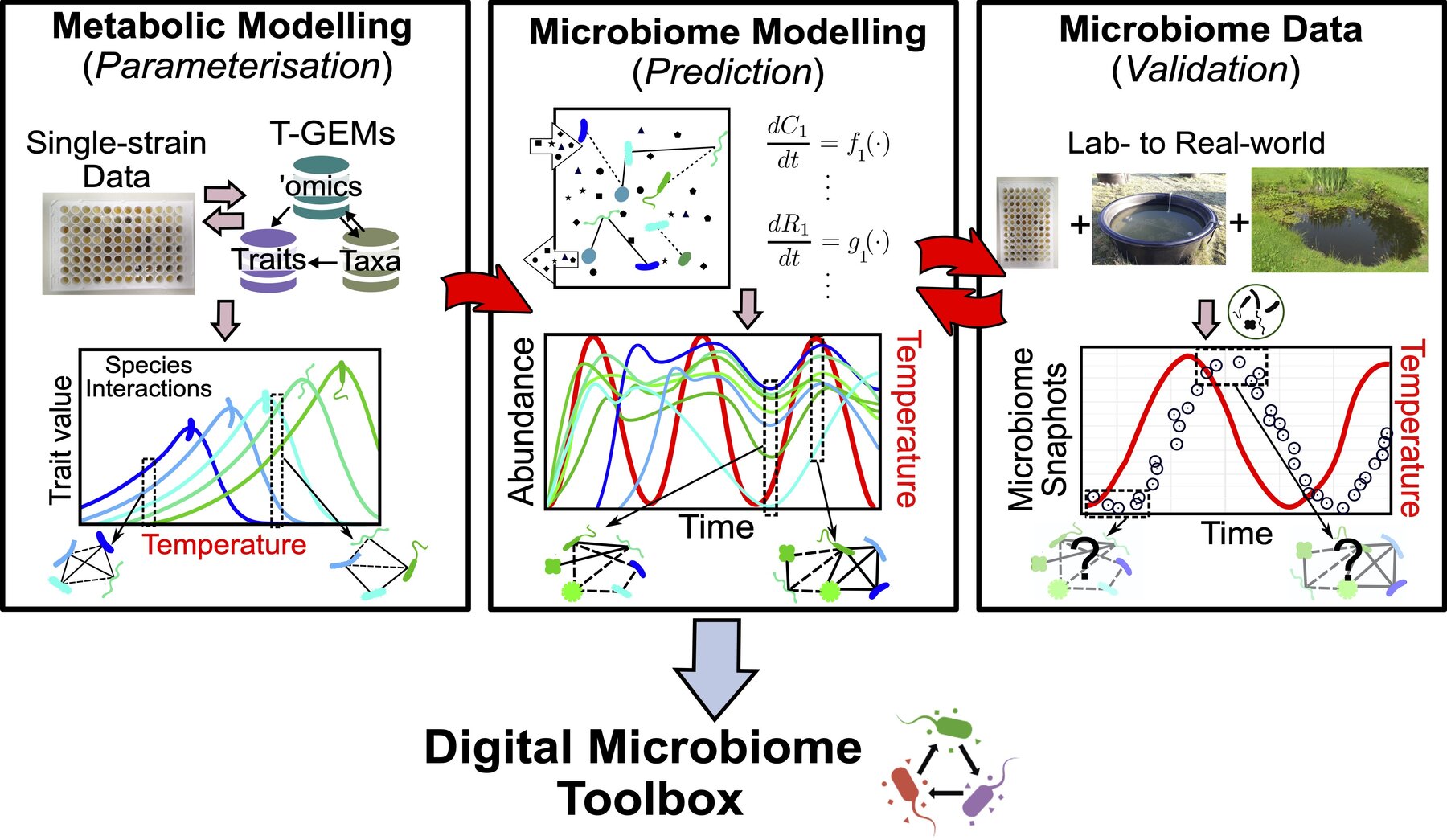
The DigiMic vision connects metabolic parameterisation to predictive community models and validation against laboratory and field observations. Metabolic-model interfaces and automated omics-based parameterisation are development goals rather than current package features.
From omics to community dynamics
The long-term DigiMic workflow connects three layers:
- Metabolic parameterisation: use strain-level measurements, traits, taxonomic information, omics data, and genome-scale metabolic models to derive biologically grounded uptake, secretion, and biomass-production parameters.
- Microbiome modelling: use those parameters in consumer-resource models to predict changes in community composition, resource chemistry, and carbon processing under different environmental conditions.
- Data and validation: compare predictions with laboratory experiments and observations from real microbial communities, then use discrepancies to refine model assumptions and parameterisation.
The modelling layer is available today. Current simulations use synthetic parameter generators or parameters supplied by the researcher. TPCP is being developed as a separate, general parameterisation package to translate genome-scale metabolic models (GEMs) and supporting biological or environmental information into consumer-resource model parameters usable by either DigiMicPy or DigiMic.jl. Temperature-aware parameterisation is a key application within that broader GEM-to-CRM bridge, rather than its sole purpose.
What is available today?
DigiMic currently has independent Python and Julia implementations that share scientific aims. Numerical and API parity between them has not been established.
DigiMicPy
The tested Python package supports:
- synthetic microbial communities with modular resource preferences;
- simulation of consumer and resource trajectories;
- configurable uptake, leakage, mortality, resource supply, and loss.
Fixed-temperature scaling and conservative spatial coupling are under active integration. Package documentation records which capabilities are present in the version or branch being used.
The platform documentation defines shared workflows for community coalescence, carbon-use efficiency, resource-flux summaries, effective generalised Lotka-Volterra reductions, and stability analysis. Package documentation records which parts have a supported implementation.
Read the DigiMicPy documentation View the Python source Explore shared workflows
DigiMic.jl
The Julia implementation provides parameter generation, SciML-based
consumer-resource simulations, local stability analysis, and experimental
stressor utilities. The repository is branded DigiMic.jl, while the package
name used in Julia imports (using MiCRM) and its UUID remain MiCRM for
compatibility with existing users.
An open framework
DigiMic is intended as a transparent foundation for collaboration across microbiology, ecology, metabolic modelling, bioinformatics, and environmental science. Planned extensions include metabolic-model interfaces, new parameterisation methods, inference tools, experimental-design workflows, and validation against measurements of community composition, resource chemistry, and carbon fluxes.
Contributions can take the form of code, independently developed extensions, examples, datasets, or feature requests motivated by concrete research questions. The project will keep implemented capabilities and research directions clearly distinguished as the framework develops.